AI-Driven Manufacturing Guide: AI Technologies, Automation, Production and Industry Applications
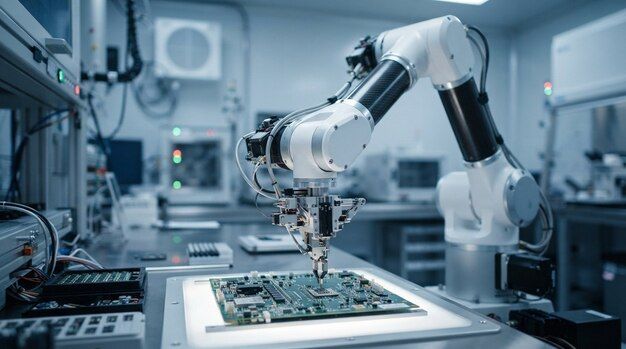
AI-driven manufacturing refers to the use of artificial intelligence technologies within factories, production systems, machinery, and industrial operations. It combines AI with automation, sensors, industrial data, robotics, computer vision, machine learning, and connected equipment to support activities across the manufacturing process.
Context
The concept developed from earlier forms of industrial automation. Traditional automation relied mainly on programmed instructions that performed predefined tasks. AI introduces systems that can analyze data, identify patterns, detect unusual conditions, and support decisions based on information collected from production environments.
Modern factories can generate large amounts of information through machines, sensors, cameras, programmable controllers, enterprise systems, and production records. AI technologies can process this information to identify patterns that may be difficult to recognize manually.
AI-driven manufacturing does not represent one particular machine or software category. It is an approach that can combine several technologies depending on the production environment, such as predictive maintenance, automated inspection, production planning, process monitoring, digital twins, robotics, and demand forecasting.
Main AI technologies used in manufacturing
Several technologies contribute to AI manufacturing systems:
Machine learning can identify patterns in historical and real-time production data.
Computer vision can analyze images from cameras to detect visual characteristics or irregularities.
Predictive analytics can estimate possible future conditions from available data.
Generative AI can assist with documentation, information retrieval, technical communication, and selected engineering workflows.
Robotics can combine programmed motion with AI-based perception and decision-making.
Digital twins can represent physical equipment or production processes in a digital environment for analysis and simulation.
These technologies can be used individually or connected within a broader industrial automation architecture.
Importance
AI-driven manufacturing matters because production environments involve many interconnected processes. A change in machine condition, material quality, production scheduling, or process settings can affect other parts of an operation.
AI can help organizations analyze these relationships more systematically. Instead of relying only on fixed thresholds or manually reviewed records, an AI system can examine larger datasets and identify patterns that may require further investigation.
Production and quality applications
AI technologies are being applied across several manufacturing activities. Common examples include:
Predictive maintenance, where machine data is analyzed to identify patterns associated with equipment deterioration.
Visual inspection, where cameras and computer vision examine products or components for specified characteristics.
Production scheduling, where algorithms analyze production requirements, machine availability, and other constraints.
Process monitoring, where sensor information is analyzed for unusual operating patterns.
Energy analysis, where historical and real-time information can be examined to understand energy-use patterns.
Inventory planning, where production and material data can support planning decisions.
Digital twin applications, where virtual representations of equipment or processes are used for simulation and analysis.
The practical value of an AI system depends heavily on data quality, system design, operating conditions, and how its outputs are interpreted.
AI and industrial automation
Industrial automation generally performs tasks through programmed control systems, while AI can add analytical capabilities to those systems. For example, an automated production line may already control machine movement, while an AI layer analyzes sensor information to identify an unusual operating pattern.
This distinction is important because AI does not necessarily replace existing automation. In many applications, it works alongside programmable controllers, sensors, robots, manufacturing execution systems, and other industrial technologies.
Common AI manufacturing applications
| Manufacturing area | AI technology | Typical purpose |
|---|---|---|
| Equipment monitoring | Machine learning | Identify unusual operating patterns |
| Quality inspection | Computer vision | Examine products or components |
| Production planning | Predictive analytics | Analyze schedules and constraints |
| Process control | Data analytics | Identify process changes |
| Maintenance planning | Predictive models | Estimate maintenance needs |
| Product development | Digital twins | Simulate designs and processes |
| Factory information | Generative AI | Organize and retrieve technical information |
AI applications can range from relatively simple analytical models to complex systems involving multiple data sources and automated decision workflows.
Recent Updates
Between 2024 and 2026, AI manufacturing has increasingly expanded from individual analytical applications toward broader industrial AI systems. Manufacturers and technology developers have placed greater attention on combining AI with connected machinery, digital twins, computer vision, robotics, and industrial data platforms.
Generative AI has also become part of the manufacturing technology discussion. Its potential uses include technical documentation, knowledge retrieval, maintenance information, engineering assistance, and interaction with industrial data. At the same time, organizations have had to consider accuracy, data protection, access control, and human review when applying generative AI in production environments.
NIST released a Generative AI Profile for its AI Risk Management Framework in 2024. The profile provides a structured way to consider risks associated with generative AI throughout its lifecycle.
Digital twins are another continuing area of development. AI can be combined with digital representations of machines or production systems to analyze operating conditions, simulate changes, and support maintenance planning. NIST's manufacturing material describes digital twins as a use case for process simulation, lifecycle analysis, and virtual testing.
Another trend is greater attention to AI risk management. NIST's AI Risk Management Framework is being revised, while a new profile concerning trustworthy AI in critical infrastructure was introduced in 2026. These developments reflect a broader movement toward structured evaluation of AI systems rather than focusing only on technical capability.
Laws or Policies
AI-driven manufacturing can be affected by several layers of rules. These may include industrial safety requirements, machinery regulations, data-protection rules, cybersecurity requirements, product regulations, workplace rules, and AI-specific legislation.
The applicable requirements depend on where an AI-enabled manufacturing system is developed, deployed, or placed on a market. Because regulations differ between jurisdictions, manufacturers generally need to consider the rules applicable to their specific operations rather than assuming that one regulatory framework applies everywhere.
AI legislation has also become more significant. The European Union's AI Act establishes requirements for certain categories of AI systems based on their risk level. The European Commission's current guidance indicates that certain AI systems integrated into products such as robotics and industrial machinery fall within future high-risk requirements under the stated regulatory timeline.
Risk-management frameworks can also influence organizational practices even where they are not legally mandatory. NIST's AI Risk Management Framework is a voluntary framework built around four functions: govern, map, measure, and manage. It is intended to help organizations identify and address AI-related risks throughout the system lifecycle.
Manufacturing organizations may therefore need to consider not only whether an AI application performs its intended technical function, but also issues such as traceability, cybersecurity, data governance, human oversight, system testing, and applicable product-safety requirements.
Tools and Resources
Several resources can help readers understand AI-driven manufacturing and organize AI-related industrial projects.
AI risk-management resources
The NIST AI Risk Management Framework provides terminology, practices, and a structured approach for considering AI risks. Its accompanying Playbook contains suggested actions associated with the framework's four functions.
Industrial data platforms
Manufacturing data platforms can collect information from sensors, machines, production systems, and other industrial sources. These platforms can provide the data foundation required for analytics and machine-learning applications.
Digital twin tools
Digital twin platforms create digital representations of physical equipment, production lines, or processes. Depending on the platform, they can support simulation, monitoring, visualization, and analysis.
Computer vision systems
Industrial computer vision tools use cameras and image-processing algorithms to analyze components, products, labels, surfaces, or production activities. AI-based vision models can be trained for particular inspection tasks when suitable image data is available.
AI project documentation
A structured AI project record can include:
Intended purpose and operating environment
Data sources and data quality information
Model or algorithm description
Performance measurements
Human review requirements
Cybersecurity considerations
Monitoring and maintenance procedures
Known limitations and potential failure conditions
Documentation can help technical and non-technical teams understand how an AI system is expected to function and where its outputs require additional review.
FAQs
What is AI-driven manufacturing?
AI-driven manufacturing uses artificial intelligence with industrial equipment, automation, data systems, sensors, robotics, and production processes. Applications can include predictive maintenance, computer vision, process analysis, production planning, and digital twins.
How is AI used in manufacturing automation?
AI can analyze machine data, recognize visual patterns, identify unusual operating conditions, and support production decisions. It can work alongside conventional automation rather than necessarily replacing existing control systems.
What are the main AI technologies used in manufacturing?
Common technologies include machine learning, computer vision, predictive analytics, robotics, digital twins, and generative AI. The appropriate technology depends on the production task, available data, system architecture, and operating requirements.
Can AI improve manufacturing quality control?
AI-based quality control can analyze images, sensor readings, and production information to identify patterns associated with specified quality conditions. Results depend on training data, inspection design, environmental conditions, and ongoing system evaluation.
What are the main challenges of AI-driven manufacturing?
Common challenges include data quality, cybersecurity, integration with existing industrial systems, model reliability, system maintenance, workforce training, and appropriate human oversight. Regulatory requirements may also apply depending on the technology and location.
Conclusion
AI-driven manufacturing combines artificial intelligence with industrial automation, production equipment, data systems, robotics, and analytical technologies. Its applications include equipment monitoring, quality inspection, production planning, digital twins, process analysis, and technical information management. Developments from 2024 through 2026 show increasing attention to generative AI, industrial data integration, digital twins, and structured AI risk management. The practical use of these technologies depends on suitable data, system design, technical evaluation, cybersecurity, human oversight, and applicable regulatory requirements.