Blow Molding Machine Details: Machine Components, Types, Materials and Manufacturing
A blow molding machine is industrial equipment used to produce hollow plastic parts by shaping heated plastic inside a mold. The process is widely associated with containers, bottles, tanks, ducts, automotive components, and other hollow products that require a controlled internal space.
Context
A blow molding machine is industrial equipment used to produce hollow plastic parts by shaping heated plastic inside a mold. The process is widely associated with containers, bottles, tanks, ducts, automotive components, and other hollow products that require a controlled internal space.
Blow molding developed from earlier plastic-forming methods as manufacturers needed practical ways to create hollow shapes in larger quantities. The basic principle is relatively simple: plastic is heated until it becomes formable, placed or positioned inside a mold, and expanded against the mold surface using air pressure.
A typical blow molding machine combines several mechanical and control systems. Depending on the process, these can include a plasticizing unit, extrusion or preform system, mold assembly, clamping mechanism, air system, cooling circuits, hydraulic or electric drives, sensors, and a control system.
How the process works
The exact sequence depends on the type of blow molding machine, but the main stages generally include:
- Plastic preparation: Polymer material is supplied in a form suitable for processing.
- Heating and plasticizing: The material is heated and transformed into a form that can be shaped.
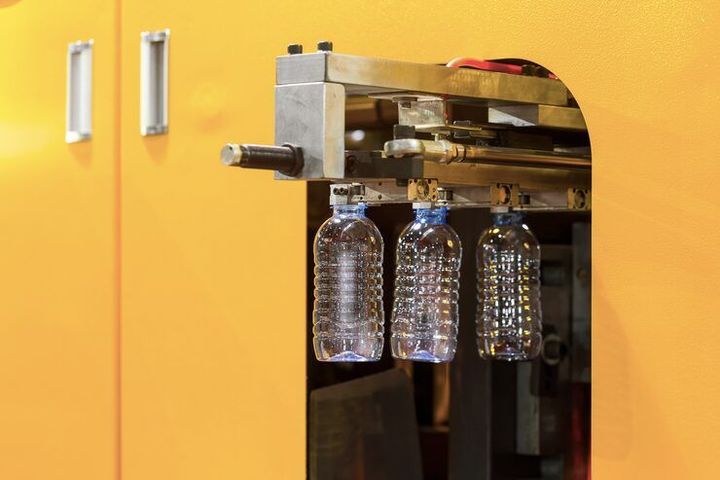
- Parison or preform formation: The machine creates either a hollow tube called a parison or a prepared preform.
- Mold closing: The mold surrounds the parison or preform.
- Air expansion: Compressed air expands the material against the internal mold surface.
- Cooling: The shaped plastic cools while remaining inside the mold.
- Mold opening: The finished part is removed after sufficient solidification.
- Trimming and inspection: Excess material may be removed and the part can undergo dimensional or visual checks.
The sequence and equipment arrangement vary between extrusion blow molding, injection blow molding, and stretch blow molding.
Importance
Blow molding is important because hollow plastic products are used across packaging, household products, transportation, industrial equipment, and other manufacturing applications. The process allows manufacturers to form relatively complex hollow structures from thermoplastic materials.
For general users, the technology may be most visible through plastic bottles and containers. In industrial environments, however, blow molding can also be associated with larger components such as storage containers, ducts, reservoirs, and selected vehicle parts.
Manufacturing considerations
The performance of a blow molding operation depends on several interacting factors. These include material properties, temperature control, mold design, air pressure, cooling conditions, cycle timing, and machine settings.
Common considerations include:
- Wall thickness: The distribution of plastic through the finished part affects dimensions and mechanical characteristics.
- Material selection: Different polymers behave differently during heating, stretching, cooling, and forming.
- Mold design: Cavity geometry determines the external shape of the product.
- Cooling: Controlled cooling helps the molded part maintain its intended dimensions.
- Process control: Temperature, pressure, timing, and movement must remain within appropriate process ranges.
- Quality inspection: Finished parts may be checked for dimensions, appearance, leaks, weight, and other relevant characteristics.
Main machine components
Although configurations vary, a blow molding machine commonly contains several major components.
| Component | General function |
|---|---|
| Hopper | Holds plastic material before processing |
| Barrel and screw | Convey and plasticize polymer in extrusion-based systems |
| Heating zones | Raise and regulate material temperature |
| Die head | Forms the parison in extrusion blow molding |
| Preform system | Produces or handles preforms in applicable processes |
| Mold | Defines the external shape of the product |
| Clamping unit | Opens and closes the mold and maintains closure |
| Air system | Supplies air used to expand the plastic |
| Cooling system | Removes heat from the mold and molded part |
| Control system | Coordinates machine movements and process parameters |
| Sensors | Monitor selected temperatures, pressures, positions, or other conditions |
Not every machine contains every component in the same configuration. Injection and extrusion systems, for example, have different material-forming arrangements.
Recent Updates
Recent developments in blow molding have generally focused on process control, energy management, material efficiency, automation, and integration with digital manufacturing systems. These developments are not limited to one particular machine design.
Greater process monitoring
Modern equipment increasingly uses sensors and electronic control systems to monitor process conditions. Data from temperature, pressure, position, and other sensors can help operators understand whether a process is remaining within its defined operating range.
Digital controls can also record production information and support repeatable machine settings. The actual capabilities vary substantially between machine models and manufacturing environments.
Energy and material efficiency
Manufacturers continue to investigate ways to reduce unnecessary heating, cooling, compressed-air use, and material consumption. Lightweighting is another area of development, where product geometry and processing conditions are studied to reduce material use while maintaining required performance.
Material efficiency also involves managing excess plastic generated during trimming and evaluating whether suitable production scrap can be incorporated into an approved material-handling process.
Automation and inspection
Automation is increasingly connected with material handling, mold changes, product removal, leak testing, dimensional inspection, and packaging-related processes. Machine-vision systems may also be used for selected inspection tasks.
Automation does not eliminate the need for process engineering or quality controls. Its role is to perform defined tasks consistently according to the parameters established for a particular production process.
Recyclable and alternative materials
Blow molding continues to adapt to changes in polymer selection and material-processing practices. Recycled polymer content, material compatibility, contamination control, and processing stability are important technical considerations when recycled materials are incorporated into production.
The suitability of a material depends on the intended application, processing method, product specifications, and applicable technical requirements.
Laws or Policies
Blow molding machines are industrial manufacturing equipment, so their operation can be affected by several categories of workplace and environmental requirements. The exact rules vary according to the country, region, industry, machine configuration, and intended product.
Rather than relying on a single rule, manufacturers and facility operators may need to consider requirements concerning machinery safety, electrical systems, pressure-related equipment, workplace conditions, emissions, waste management, and plastic materials.
Machinery and workplace safety
Industrial equipment can involve moving molds, heated surfaces, electrical systems, hydraulic components, pneumatic circuits, and rotating machinery. Safety frameworks therefore commonly address guarding, emergency controls, electrical protection, maintenance procedures, and operator safety.
Applicable requirements should be checked against the rules of the jurisdiction where the equipment is manufactured, installed, or operated.
Environmental considerations
Plastic processing can generate production scrap, packaging waste, emissions from heating processes, and other waste streams. Environmental requirements may govern how these materials and waste streams are handled.
For manufacturing facilities, compliance can depend on the type and quantity of material processed and the environmental characteristics of the operation. Requirements should therefore be evaluated according to the actual facility rather than assumed from the machine type alone.
Product-related requirements
When blow molding is used to produce containers or components intended for regulated applications, additional material and product requirements may apply. For example, packaging intended for food contact can be subject to specific material and migration requirements in the relevant jurisdiction.
The machine itself does not determine whether a finished product meets those requirements. Material selection, process controls, product design, testing, and documentation can all be relevant.
Tools and Resources
Several technical resources can help readers understand blow molding machines and their manufacturing processes.
Process diagrams and machine manuals
Machine manuals provide information about machine components, operating sequences, allowable settings, maintenance procedures, and safety instructions. Process diagrams can also help explain the relationship between the extrusion system, mold, air system, cooling system, and controls.
Material datasheets
Polymer datasheets provide information such as processing temperature ranges, density, melt characteristics, and other technical properties. These documents are useful when studying how different materials may behave during processing.
Mold and product design software
Computer-aided design and manufacturing tools can be used to develop mold cavities, evaluate product geometry, and prepare manufacturing information. Some engineering platforms also provide simulation capabilities for studying material flow and cooling.
Quality measurement equipment
Depending on the product, manufacturers may use:
- Vernier or digital calipers for dimensional checks
- Micrometers for selected thickness measurements
- Weighing equipment for product mass
- Leak-testing equipment for hollow containers
- Temperature measurement instruments
- Pressure measurement equipment
- Vision systems for selected surface inspections
The appropriate measurement method depends on the product specification and the characteristic being evaluated.
FAQs
What is a blow molding machine?
A blow molding machine is equipment that forms hollow plastic products by expanding heated polymer material inside a mold. Different machine types use different methods to create and expand the plastic.
What are the main types of blow molding machines?
The principal types include extrusion blow molding, injection blow molding, and injection stretch blow molding. They differ in how the initial plastic form is produced and how it is expanded inside the mold.
What materials are used in blow molding?
Common thermoplastics used in blow molding include polyethylene, polypropylene, polyethylene terephthalate, and selected engineering polymers. The appropriate material depends on product geometry, processing method, performance requirements, and applicable material specifications.
What are the main components of a blow molding machine?
Major components can include a hopper, screw and barrel, heating zones, die head or preform system, mold, clamping unit, compressed-air system, cooling system, sensors, and control system. The exact arrangement depends on the machine type.
How does a blow molding machine manufacture plastic products?
The machine first prepares heated plastic as a parison or preform. The material is then enclosed by a mold and expanded using air pressure so that it conforms to the cavity. After cooling, the mold opens and the formed product is removed for further processing or inspection.
Conclusion
A blow molding machine forms hollow plastic products by combining controlled heating, material preparation, mold closure, air expansion, and cooling. Extrusion, injection, and stretch blow molding use different equipment arrangements and processing sequences. Machine components, polymer characteristics, mold design, temperature control, cooling, and process monitoring all influence the manufacturing process. Recent developments have focused on automation, digital monitoring, energy management, material efficiency, and the use of different polymer inputs.