Dairy Processing Equipment Insights: Machinery, Processing Methods, Quality Control and Industry Practices
Dairy processing equipment refers to the machinery, vessels, piping systems, pumps, heat-treatment units, separators, filling systems, and cleaning equipment used to transform milk into products such as pasteurized milk, cream, yogurt, butter, cheese, milk powder, and other dairy products. These systems connect several stages, beginning with receiving and handling milk and continuing through processing, packaging, storage, and cleaning.
Context
Dairy processing developed from relatively simple manual methods into controlled industrial processes as demand for consistent dairy products increased. Modern facilities use combinations of mechanical, thermal, separation, fermentation, and refrigeration technologies to manage milk efficiently while maintaining controlled processing conditions.
Raw milk is a complex biological material containing water, proteins, fats, lactose, minerals, and other components. Its composition can vary according to animal, feed, season, and other factors. Dairy processing equipment therefore has to accommodate variation while providing controlled conditions during each processing stage.
Main stages in dairy processing
A typical dairy processing line can contain several connected operations:
- Milk reception and initial inspection
- Filtration and clarification
- Chilling and refrigerated storage
- Separation or standardization
- Homogenization
- Heat treatment
- Fermentation or further processing
- Filling and packaging
- Refrigerated or controlled storage
- Cleaning and sanitation
The exact sequence depends on the final product. Yogurt production, for example, includes fermentation, while butter production relies on cream separation and churning.
Common dairy processing equipment
Different machines perform specific functions within a processing line.
| Equipment | Main function | Common applications |
|---|---|---|
| Milk storage tank | Holds milk under controlled conditions | Milk and cream handling |
| Milk separator | Separates cream from skim milk | Cream and milk processing |
| Homogenizer | Reduces fat globule size | Fluid milk and dairy beverages |
| Pasteurization system | Applies controlled heat treatment | Fluid milk and other products |
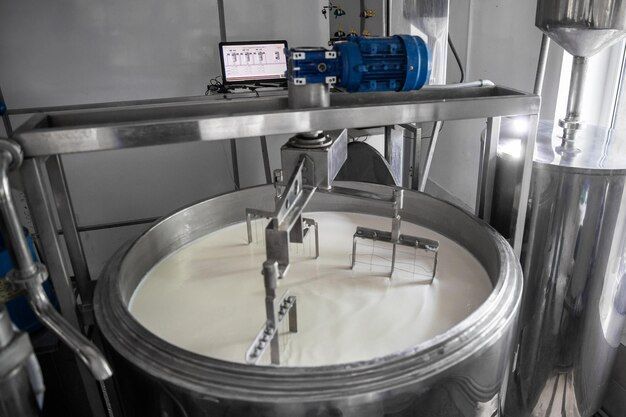
| Cheese vat | Supports controlled curd formation | Cheese production |
| Yogurt tank | Supports fermentation and controlled mixing | Yogurt production |
| Butter churn | Converts cream into butter | Butter processing |
| Evaporator | Removes part of the water | Concentrated dairy products |
| Spray dryer | Produces powdered dairy products | Milk powder production |
| Filling machine | Places processed products into containers | Packaged dairy products |
Importance
Dairy processing equipment matters because milk is highly perishable and requires controlled handling from collection through processing and storage. Processing systems help facilities manage temperature, time, flow, mixing, separation, and other variables that influence product characteristics.
For consumers, these processes affect the consistency, storage characteristics, texture, and other properties of dairy products. For processors, coordinated equipment helps create repeatable production conditions and allows different dairy products to be manufactured using specialized process lines.
Managing milk quality
Milk quality can be influenced before processing begins. Temperature control, handling practices, storage conditions, and transportation can affect the condition of incoming milk.
Once milk reaches a processing facility, initial checks may examine factors such as temperature, composition, acidity, appearance, and indicators of microbial quality. The precise testing program depends on the facility and product.
Controlling processing conditions
Many dairy processes depend on accurately controlled conditions. Examples include:
- Temperature during heat treatment
- Pressure during homogenization
- Fat and solids levels during standardization
- Time and temperature during fermentation
- Moisture levels during drying
- Cooling conditions after processing
- Flow rates through processing equipment
Monitoring these variables helps processors maintain consistency between production batches.
Hygiene and contamination control
Dairy processing facilities place considerable emphasis on hygienic design and cleaning. Equipment surfaces that contact milk are commonly constructed from materials suitable for food processing and designed to reduce areas where residues could accumulate.
Pipelines, tanks, valves, pumps, heat exchangers, and filling equipment can be incorporated into automated cleaning systems. These systems circulate cleaning solutions through equipment without requiring every component to be manually disassembled.
Recent Updates
From 2024 through 2026, dairy processing has continued to develop around automation, energy management, digital monitoring, resource efficiency, and process control. Rather than relying only on individual machines, many facilities are integrating sensors and control systems across multiple stages.
Automation and digital monitoring
Modern dairy processing equipment can incorporate sensors that measure temperature, pressure, flow, conductivity, level, and other process variables. Control systems can collect these measurements and use them to maintain defined operating conditions.
Digital records can also help operators review production information and identify changes in process performance. The level of automation varies considerably between facilities and product categories.
Membrane processing
Membrane technologies such as ultrafiltration, microfiltration, nanofiltration, and reverse osmosis continue to have applications in dairy processing. These systems use selective membranes to separate components based on characteristics such as molecular size.
Applications can include concentration of milk components, whey processing, protein enrichment, and water removal. Membrane processing can therefore reduce the need for some conventional separation or concentration steps depending on the product.
Energy and resource management
Energy efficiency has become an important engineering consideration because dairy processing can involve heating, cooling, refrigeration, evaporation, drying, compressed air, and hot-water generation.
Heat recovery systems can transfer thermal energy from one process stream to another. Water-management systems can also monitor water use and support recovery or reuse where permitted by the applicable food-safety requirements.
Advanced process control
Automation increasingly combines measurement devices with programmable control systems and data collection. This can support tighter monitoring of temperature, flow, pressure, and product composition.
However, automated monitoring does not eliminate the need for equipment inspection, calibration, sanitation controls, and appropriate human oversight.
Laws or Policies
Dairy processing is shaped by food-safety legislation, hygiene requirements, labeling rules, environmental regulations, and equipment standards. Requirements differ between jurisdictions, so processors must follow the rules applicable to their location and products.
Food regulations commonly address areas such as hygienic processing, prevention of contamination, temperature control, permitted ingredients, packaging, traceability, and labeling. Processing facilities may also be subject to inspection, recordkeeping, and verification requirements.
Internationally, the Codex Alimentarius provides internationally recognized food standards, guidelines, and codes of practice. Its General Principles of Food Hygiene and HACCP-related guidance provide a framework for identifying and controlling food-safety hazards.
In India, dairy processing is covered by the food-safety framework administered by the Food Safety and Standards Authority of India. FSSAI regulations include requirements relating to milk and milk products, hygiene, licensing, labeling, and food safety. Applicable requirements can vary according to the type of food business and product.
Dairy facilities can also use HACCP-based food-safety systems. HACCP focuses on identifying biological, chemical, and physical hazards and establishing controls at relevant stages of a food process.
Because regulations can change, current requirements should be checked with the relevant food-safety authority when compliance decisions are involved.
Tools and Resources
Several resources can help readers understand dairy processing equipment and production practices.
Process flow diagrams
A process flow diagram can show how milk moves through receiving, storage, separation, heat treatment, processing, packaging, and storage. It can also identify control points and connections between equipment.
HACCP worksheets
HACCP worksheets can organize information about:
- Process steps
- Potential hazards
- Preventive controls
- Monitoring procedures
- Corrective actions
- Verification activities
- Recordkeeping
These documents are generally part of a broader food-safety system rather than standalone equipment specifications.
Equipment specifications
Technical documentation for dairy processing equipment commonly includes information about processing capacity, temperature ranges, pressure ratings, materials, electrical requirements, connection sizes, cleaning procedures, and operating limitations.
Such information allows equipment to be considered in relation to the rest of a processing line.
Monitoring instruments
Common process-monitoring instruments include temperature sensors, pressure gauges, flow meters, level sensors, conductivity meters, pH meters, and analytical testing equipment. Calibration and verification procedures help ensure that measurement systems remain suitable for their intended use.
Cleaning systems
Clean-in-place systems are widely used in dairy plants. A typical cleaning cycle can involve rinsing, alkaline cleaning, intermediate rinsing, acidic cleaning where appropriate, and final rinsing, although the exact sequence depends on the equipment, residues, cleaning chemistry, and validated procedure.
FAQs
What is dairy processing equipment?
Dairy processing equipment includes machinery used to receive, store, separate, heat, cool, homogenize, ferment, concentrate, dry, package, and clean dairy products. Different equipment is selected according to the product and processing method.
What are the main types of dairy processing equipment?
Common types include milk storage tanks, separators, homogenizers, pasteurization systems, cheese vats, yogurt processing tanks, butter churns, evaporators, spray dryers, pumps, heat exchangers, filling machines, and cleaning systems.
How does a milk pasteurization system work?
A pasteurization system subjects milk to a controlled combination of temperature and time designed to reduce specified microorganisms while maintaining the intended characteristics of the product. The exact process conditions depend on the product and applicable food-safety requirements.
Why is homogenization used in dairy processing?
Homogenization mechanically reduces the size of fat globules in milk or dairy products. This changes the physical behavior of the fat phase and helps produce a more uniform product.
What is quality control in dairy processing?
Quality control involves monitoring raw materials, processing conditions, equipment performance, product characteristics, packaging, storage, and other relevant factors. Testing and records help determine whether defined specifications and food-safety requirements are being maintained.
Conclusion
Dairy processing equipment forms an interconnected system for handling, transforming, packaging, and storing milk and dairy products. Machinery such as separators, homogenizers, heat-treatment systems, fermentation tanks, evaporators, dryers, and filling equipment performs different functions within these processes. Current industry practices increasingly incorporate automation, digital monitoring, membrane technologies, energy management, and resource-efficiency measures. Food-safety regulations, hygienic design, process control, and documented quality procedures remain important elements of dairy processing.