Industrial Robotics Manufacturing Overview: Robot Types, Production, Automation and Applications
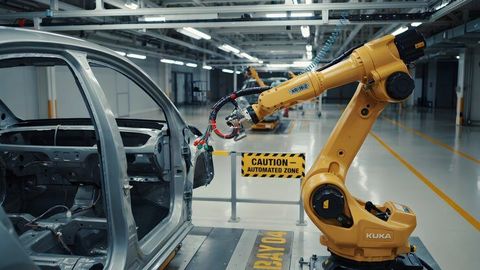
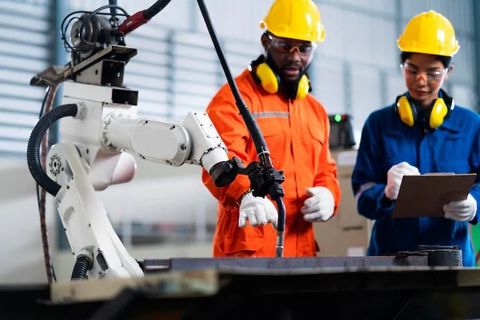
Industrial robotics manufacturing involves the design and production of robotic machines used to perform repetitive, precise, heavy, or hazardous tasks in industrial environments. An industrial robot generally consists of a mechanical structure, motors or actuators, sensors, a controller, software, and an end effector that interacts with materials or products.
Context
The development of industrial robots grew from the wider evolution of factory automation. Early systems were designed mainly for repetitive handling and production tasks, while modern robots can work with vision systems, digital controllers, sensors, and manufacturing software.
Industrial robotics manufacturing now covers several robot configurations, including articulated robots, SCARA robots, Cartesian robots, delta robots, and collaborative robots. Each type has a different mechanical arrangement and is suited to particular movements and applications.
The production of an industrial robot involves multiple stages. Mechanical components must be designed and manufactured, motors and transmission systems integrated, electronic controls configured, software developed, and the completed system tested before deployment.
Main components of an industrial robot
An industrial robot is more than a mechanical arm. Its major elements commonly include:
Robot structure: Provides the physical movement and positioning mechanism.
Actuators and motors: Generate movement at the robot joints or axes.
Controller: Processes programmed instructions and coordinates robot movement.
Sensors: Provide information about position, force, temperature, or surrounding conditions.
End effector: Performs the actual task, such as gripping, welding, painting, or handling.
Software: Controls programs, motion sequences, communication, monitoring, and configuration.
Together, these components create a robotic system that can be integrated with other manufacturing equipment.
Types of industrial robots
Robot configuration has a direct relationship with movement, working area, payload, speed, and application requirements.
| Robot type | General movement pattern | Common applications |
|---|---|---|
| Articulated robot | Multiple rotary joints | Welding, handling, assembly |
| SCARA robot | Horizontal rotary movement with vertical motion | Assembly, insertion, electronic production |
| Cartesian robot | Linear movement along coordinate axes | Pick-and-place, machining, material handling |
| Delta robot | Parallel-arm movement | Sorting, packaging, high-speed picking |
| Collaborative robot | Designed for specific collaborative applications | Assembly, inspection, handling |
| Cylindrical robot | Rotary and linear movement | Handling and machine loading |
These categories describe general configurations rather than fixed application limits. The actual capabilities depend on the specific robot, controller, tooling, software, and integrated production system.
Importance
Industrial robotics manufacturing is important because factories often need machines capable of repeating the same movement with controlled speed and positioning. Robots can be integrated into production processes where repetitive handling, welding, assembly, inspection, painting, or material movement forms part of the workflow.
Robotics also affects many industries that produce everyday products. Automotive manufacturing, electronics, metalworking, food processing, plastics, pharmaceuticals, and logistics-related production environments can use robotic equipment for different stages of production.
Manufacturing challenges addressed by robotics
Factories may face several operational challenges that influence automation decisions. These include repetitive manual movements, difficult working environments, variations in production volume, requirements for consistent positioning, and the need to coordinate several machines within one production line.
Robotic systems can address some of these challenges by performing programmed movements repeatedly. However, automation does not remove the need for system design, supervision, maintenance, quality checks, and trained personnel.
Automation and production integration
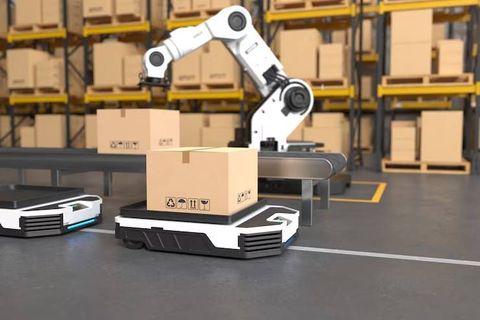
Industrial robotics rarely operates completely independently. A robot may communicate with programmable logic controllers, machine vision equipment, conveyors, CNC machines, sensors, databases, and manufacturing execution systems.
A typical automated cell can include:
Material input equipment
Industrial robot
End effector or tooling
Sensors and vision equipment
Safety-related components
Controller and programmable logic
Output or transfer equipment
The interaction between these elements is important because the robot's performance depends on the complete cell rather than the robotic arm alone.
Robot production process
Industrial robot production begins with requirements for payload, reach, movement, accuracy, environmental conditions, and intended application. Engineers then develop the mechanical structure, drive system, control architecture, and software.
Manufacturing generally involves machining or forming structural components, producing precision transmission components, assembling motors and joints, installing electronics, and integrating control systems. Calibration and functional testing follow assembly.
Testing may examine movement accuracy, repeatability, load handling, communication, software functions, and safety-related features. The exact procedures vary according to the robot design and intended application.
Recent Updates
Industrial robotics has continued to develop rapidly during 2024–2026, with greater attention to artificial intelligence, machine vision, collaborative operation, digital integration, and flexible production.
According to the International Federation of Robotics, 542,000 industrial robots were installed worldwide in 2024, while the global operational stock reached about 4.66 million units. The organization reported that annual installations remained above 500,000 units for the fourth consecutive year.
More recent IFR reporting indicates that industrial robot installations exceeded 600,000 units in 2025, with the global operational stock exceeding five million robots. The same report identified electronics, automotive, and metal and machinery production as major areas of demand.
Artificial intelligence and machine vision
Artificial intelligence is increasingly being explored in industrial robotics for perception, planning, inspection, and adaptation. Machine vision can help robots identify objects, inspect products, and respond to variations in position or appearance.
The International Federation of Robotics has identified analytical, physical, and generative AI as important robotics trends. These technologies are being developed alongside simulation tools and specialized computing hardware.
AI does not mean that every industrial robot can independently make production decisions. In many applications, AI remains one component within a controlled automation system.
Flexible and collaborative robotics
Manufacturing is also moving toward more flexible robotic systems. Collaborative robots are designed for specific applications where interaction between people and robotic equipment is considered during system design.
The growing use of sensors, vision systems, easier programming interfaces, and modular tooling can support production environments where product types or production requirements change more frequently.
Laws or Policies
Industrial robotics manufacturing is influenced by machinery safety regulations, occupational safety requirements, electrical standards, electromagnetic compatibility rules, and product conformity requirements. The exact legal requirements depend on the jurisdiction, application, workplace, and equipment configuration.
International standards provide technical frameworks that manufacturers and integrators can use when designing and evaluating robotic systems. They do not replace applicable laws or regulatory requirements.
A significant recent development is the publication of ISO 10218-1:2025, which addresses safety requirements for industrial robots. ISO 10218-2:2025 addresses industrial robot applications and robot cells, including integration, commissioning, operation, maintenance, and decommissioning.
Safety considerations
Robot safety involves the complete application rather than only the robotic arm. Hazards can arise from robot movement, tooling, materials, surrounding machinery, unexpected movement, stored energy, or the interaction between different pieces of equipment.
Risk assessment, protective measures, safeguarding, emergency functions, operating procedures, and appropriate training are therefore important parts of an industrial robotics system.
The relevant requirements can differ according to the application. Welding, machining, painting, material handling, and other processes may introduce additional hazards that need to be considered during system design.
Tools and Resources
Several technical resources can help readers understand industrial robotics manufacturing, automation, and robot applications.
Robotics standards and technical references
ISO publications provide internationally recognized frameworks covering industrial robot safety and robot-cell integration. The ISO robotics committee also maintains information about standards covering industrial and other robotic systems.
Robot simulation software
Robot simulation platforms allow engineers to create virtual production cells, test movement sequences, examine reach, and identify potential collisions before physical installation. Simulation can also help evaluate cycle sequences and equipment layouts.
Robot configuration tools
Robot manufacturers commonly provide programming environments and configuration tools for defining motion paths, payload information, coordinates, end-effectors, and communication settings. These tools vary according to the robot platform.
Industry statistics
The International Federation of Robotics publishes global information about robot installations, operational stock, robot density, and industry trends. Such statistics can help readers understand broader developments in industrial automation.
Production planning resources
Manufacturing teams may also use process-flow diagrams, robot-cell layouts, cycle-time calculations, risk-assessment documents, maintenance records, and equipment specifications when planning an automated production system.
FAQs
What is industrial robotics manufacturing?
Industrial robotics manufacturing is the process of designing, producing, assembling, testing, and integrating robots intended for industrial applications. It includes mechanical structures, motors, controllers, sensors, software, and application-specific tooling.
What are the main types of industrial robots?
Common industrial robot types include articulated, SCARA, Cartesian, delta, cylindrical, and collaborative robots. Their configurations differ in movement, reach, payload, and typical applications.
How are industrial robots manufactured?
Industrial robots are manufactured through stages that can include mechanical design, component production, precision assembly, motor and controller integration, software configuration, calibration, and functional testing. The exact production process depends on the robot architecture.
How are industrial robots used in manufacturing?
Industrial robots can be used for welding, assembly, material handling, machine loading, painting, inspection, packaging, palletizing, and other repetitive production tasks. Their suitability depends on factors such as payload, reach, speed, tooling, environment, and process requirements.
What safety standards apply to industrial robots?
Industrial robot safety is addressed by standards such as ISO 10218-1:2025 for industrial robots and ISO 10218-2:2025 for industrial robot applications and robot cells. Applicable national laws and workplace requirements must also be considered.
Conclusion
Industrial robotics manufacturing combines mechanical engineering, electronics, control systems, software, sensors, and automation into equipment designed for industrial production. Articulated, SCARA, Cartesian, delta, cylindrical, and collaborative robots serve different movement and application requirements. Recent developments have focused on AI, machine vision, flexible automation, connected production systems, and updated safety standards. The performance and safety of a robotic system depend on the robot itself as well as its tooling, software, surrounding equipment, and overall application design.