How Industrial Sensors Quietly Power the Modern Smart Factory
Industrial sensors are small but important components used to detect physical conditions inside factories and production environments. They can measure factors such as temperature, pressure, position, vibration, speed, flow, level, humidity, light, and proximity. The collected information can then be sent to control systems, machines, or industrial software for further processing.
Context
The idea behind industrial sensing is not new. Traditional factories have long used switches, gauges, meters, and other instruments to observe machine conditions and production processes. The development of automation introduced electronic sensors that could continuously detect changes and send signals to programmable control systems.
Modern smart factories build on this foundation by connecting sensors with programmable logic controllers, industrial networks, edge computers, data platforms, and machine-monitoring systems. Instead of relying only on manual observation, production equipment can continuously generate operational data.
How industrial sensors work
An industrial sensor converts a physical condition into a usable signal. For example, a temperature sensor detects changes in temperature and produces an electrical signal that a control system can interpret.
Depending on the sensor type, the output may be an electrical voltage, current, digital signal, switching signal, or network message. The receiving system can use that information to display a condition, adjust equipment, record data, or initiate another programmed action.
Common industrial sensor types
Different manufacturing processes require different forms of sensing. Common examples include:
Temperature sensors for monitoring heat in equipment and processes
Pressure sensors for detecting pressure in pneumatic, hydraulic, and process systems
Proximity sensors for detecting the presence or position of objects
Photoelectric sensors for detecting objects using light
Level sensors for monitoring liquids, powders, and other materials
Flow sensors for measuring the movement of liquids or gases
Vibration sensors for observing mechanical movement
Position sensors for tracking movement or location
Humidity sensors for monitoring moisture in air or controlled environments
The choice depends on the physical variable being measured, operating conditions, required measurement range, installation location, and control-system architecture.
Importance
Smart manufacturing depends on timely information. A machine controller can only respond to changing conditions when suitable information is available, and industrial sensors provide much of that information at the equipment level.
Sensors can help production systems observe conditions that may not be visible to operators. Temperature changes, abnormal vibration, pressure fluctuations, material presence, or unexpected movement can be detected electronically and passed to another system.
Sensors as the factory's information layer
A useful way to understand smart factory architecture is to think of sensors as an information layer between physical equipment and digital systems.
A simplified flow looks like this:
Physical process → Sensor → Controller → Industrial network → Software or monitoring system
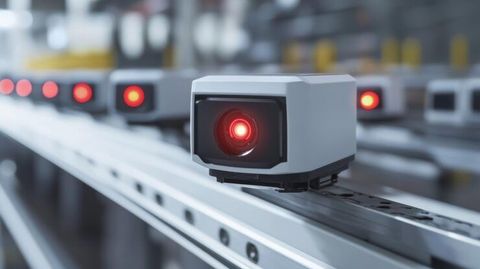
For example, a sensor installed near a conveyor may detect whether a component has reached a particular position. A controller receives that signal and can use programmed logic to coordinate another machine operation.
This relationship allows automation systems to react to physical conditions rather than relying entirely on manual observation.
Why sensor data matters
Sensor data can support several industrial activities:
Process monitoring
Equipment condition monitoring
Quality checks
Production tracking
Automated control
Energy monitoring
Safety-related machine functions
Fault investigation
Maintenance planning
Sensors themselves do not determine whether a factory is "smart." Their value comes from how accurately the information is collected, communicated, interpreted, and used within the wider automation system.
Common challenges
Industrial sensing also presents practical challenges. Sensors operate in environments that may contain dust, moisture, vibration, heat, chemicals, electrical interference, or mechanical movement.
Incorrect installation, unsuitable measurement ranges, damaged wiring, poor alignment, contamination, or incorrect configuration can produce unreliable signals. For this reason, sensor selection and installation are important parts of an industrial automation design.
Recent Updates
From 2024 through 2026, industrial sensing has increasingly become connected with broader developments in industrial automation, edge computing, artificial intelligence, digital twins, and the Industrial Internet of Things.
One important trend is the movement from isolated sensor signals toward connected sensing systems. Modern industrial networks can allow information from multiple sensors and machines to reach local computing equipment or centralized data platforms.
Edge processing
Edge computing is becoming more relevant where industrial systems need to process information close to the equipment generating it. Instead of sending every measurement to a distant system for processing, selected information can be analyzed locally.
This approach can reduce unnecessary data transmission and can support applications where rapid response or local availability of information matters.
Smarter condition monitoring
Vibration, temperature, current, pressure, and acoustic measurements are increasingly used together to understand equipment condition. Multiple sensor signals can provide a broader view of how machinery is operating than a single measurement.
Machine-learning systems may also analyze historical sensor patterns to identify unusual behavior. Such systems should be treated as analytical tools rather than infallible decision makers because data quality and operating conditions influence their results.
More connected sensors
Industrial sensor technology is also moving toward greater connectivity. Depending on the factory architecture, sensors may communicate through established industrial protocols or newer network technologies.
| Sensor category | Typical measurement | Common industrial use |
|---|---|---|
| Temperature | Heat level | Process and equipment monitoring |
| Pressure | Fluid or gas pressure | Hydraulic and process systems |
| Proximity | Object presence | Position detection |
| Flow | Fluid or gas movement | Process monitoring |
| Level | Material height | Tanks and containers |
| Vibration | Mechanical movement | Equipment condition monitoring |
| Position | Location or movement | Automated machinery |
| Humidity | Moisture in air | Controlled environments |
The broader trend is toward combining sensor data with automation and analytics rather than treating each measurement as an isolated signal.
Laws or Policies
Industrial sensor systems can be affected by several types of technical rules and regulatory requirements, depending on the equipment, industry, application, and location.
There is no single global law governing every industrial sensor. Requirements may relate to electrical safety, electromagnetic compatibility, machinery safety, functional safety, hazardous environments, data security, environmental conditions, or industry-specific processes.
International standards organizations such as the International Electrotechnical Commission and the International Organization for Standardization publish standards relevant to industrial automation, electrical equipment, machinery, measurement, and functional safety.
Industrial safety considerations
Some sensors are part of safety-related control systems. Examples include devices used to detect machine access, hazardous movement, or specific operating conditions. In such applications, the sensor's role is different from ordinary process monitoring because the complete control system may have defined safety requirements.
The applicable requirements depend on the machine and its intended application. Technical documentation, risk assessment, system architecture, installation procedures, and validation activities can all be relevant.
Cybersecurity considerations
Connected industrial sensors also introduce cybersecurity considerations. Once sensors communicate through industrial networks, the wider system may need controls for access management, network segmentation, software updates, device configuration, and data protection.
Cybersecurity requirements vary by organization and application. Industrial operators commonly consider cybersecurity as part of the wider automation architecture rather than treating each sensor as an isolated device.
Tools and Resources
Several technical resources can help readers understand industrial sensors and smart-factory architecture.
Sensor selection guides
Manufacturer datasheets and engineering documentation usually provide information such as sensing range, environmental limits, electrical characteristics, connection methods, response behavior, and mounting requirements. These specifications help engineers understand whether a sensor is suitable for a particular application.
Industrial automation standards
Standards databases maintained by recognized technical organizations can provide information about automation, electrical equipment, machinery safety, measurement, and communication technologies. The specific standard depends on the equipment and application.
PLC programming environments
Programmable logic controller software is commonly used to configure how sensor signals interact with automated machinery. These environments allow engineers to create logic that responds to inputs and controls outputs.
Data-monitoring platforms
Industrial monitoring platforms can collect sensor information and display measurements through dashboards, trends, alarms, or reports. Depending on the system, data may be processed locally at the edge or transferred to a wider industrial data platform.
Digital twins
A digital twin is a digital representation of a physical asset, process, or system. Sensor data can provide information about the physical system that helps keep the digital representation aligned with operating conditions.
FAQs
What are industrial sensors used for in a smart factory?
Industrial sensors detect physical conditions such as temperature, pressure, position, vibration, flow, and material presence. Their signals can be used by controllers, monitoring systems, and industrial software to understand and manage production processes.
How do industrial sensors support factory automation?
Industrial sensors provide information about the physical state of machinery and production processes. A controller can use these signals as inputs for programmed operations, allowing equipment to respond to detected conditions.
What types of industrial sensors are commonly used?
Common industrial sensors include temperature sensors, pressure sensors, proximity sensors, photoelectric sensors, flow sensors, level sensors, vibration sensors, position sensors, and humidity sensors. The appropriate type depends on the condition that needs to be measured.
How do sensors contribute to predictive maintenance?
Sensors can continuously collect information about conditions such as vibration, temperature, pressure, or electrical behavior. Historical measurements can then be analyzed for patterns that may indicate changes in equipment condition. Predictive maintenance systems depend on appropriate data quality and analysis methods.
What is the difference between a traditional sensor and a smart sensor?
A traditional sensor may primarily provide a basic electrical signal representing a measured condition. A smart sensor can include additional processing, diagnostics, communication functions, configuration capabilities, or digital interfaces, depending on its design.